Order a single 11×14 frame in the wrong size and you return it. Order three hundred and you have a pallet of product that fits nothing you print. Buying frames in bulk rewards getting the dimensions right the first time, and the encouraging part is that the American frame market is far more standardized than it first looks. Once you understand the handful of sizes buyers actually reach for and the geometry underneath them, speccing a large run becomes a short, repeatable decision instead of a gamble.
The three aspect ratios almost every standard size follows
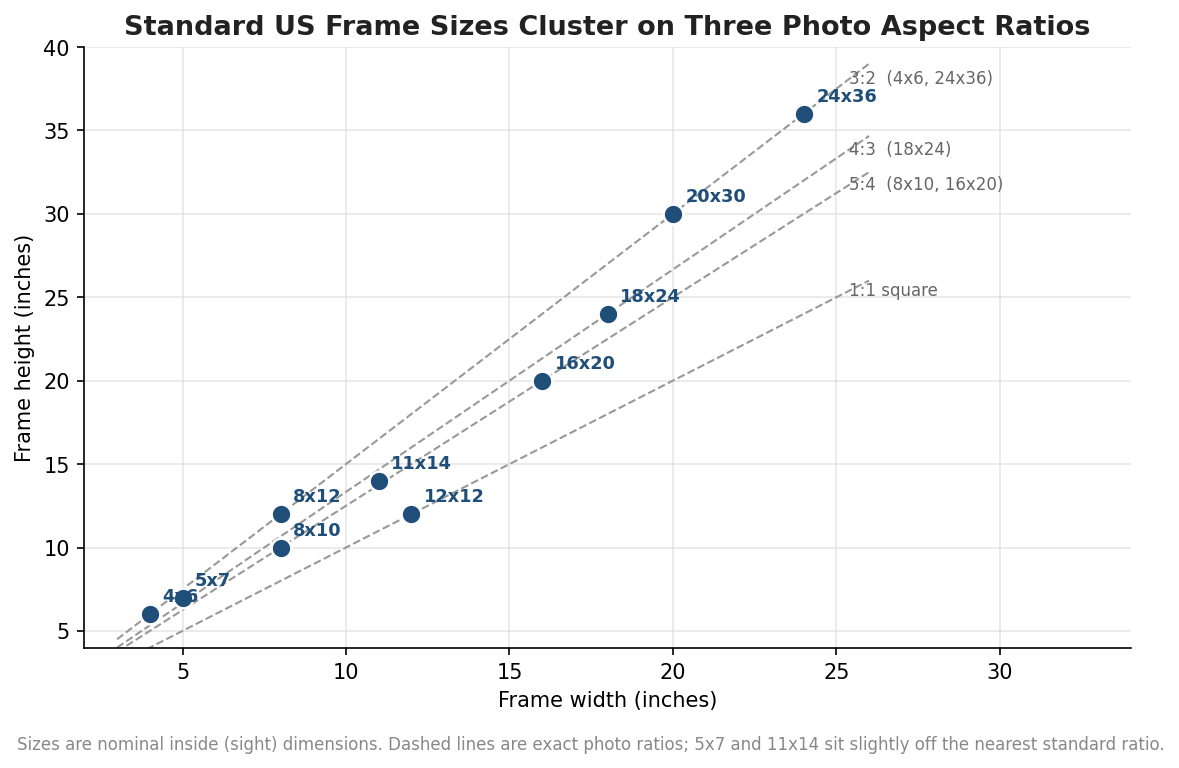
A frame size is really two numbers, and those two numbers form a ratio. Most of the sizes that sell in volume land on just three of them. The 3:2 ratio covers 4×6, 8×12, 20×30 and 24×36, and it matches the native output of most digital cameras and phone sensors, so it is what you want when you are framing straight photographic prints with no cropping. The 5:4 ratio covers 8×10 and 16×20, the traditional portrait-studio proportion, slightly squarer than a camera frame. The 4:3 ratio appears at 18×24 and is common for posters. A few perennial favorites sit deliberately off-ratio: 5×7 and 11×14 are neither cleanly 3:2 nor 5:4, which is exactly why prints often need a small crop or a mat to sit in them cleanly. The chart below plots the common sizes against those reference ratios so the clustering is visible at a glance.
Where the common sizes actually get used
Sizes group into three practical tiers. Tabletop and small wall runs from 4×6 through 8×10, the desk-and-shelf sizes that move in the highest unit counts for events, proofs and gifts. Mid-wall covers 11×14, 12×16, 16×20 and 18×24, the range most people picture when they imagine a framed piece on a wall, and the sweet spot for retail displays and hospitality decor. Large and poster starts around 20×30 and runs to 24×36 and beyond, where weight and glazing choice begin to matter more than they do at small sizes. Frame makers tend to cap out somewhere in the high-twenties-by-thirties or low-forties range on a side because moulding and glazing are manufactured in finite lengths; past that you are into oversized construction. If your run spans several tiers, plan to standardize hardware and packaging separately for each, because a 5×7 and a 24×36 do not hang, pack or ship the same way.
How a mat changes the size you need to order
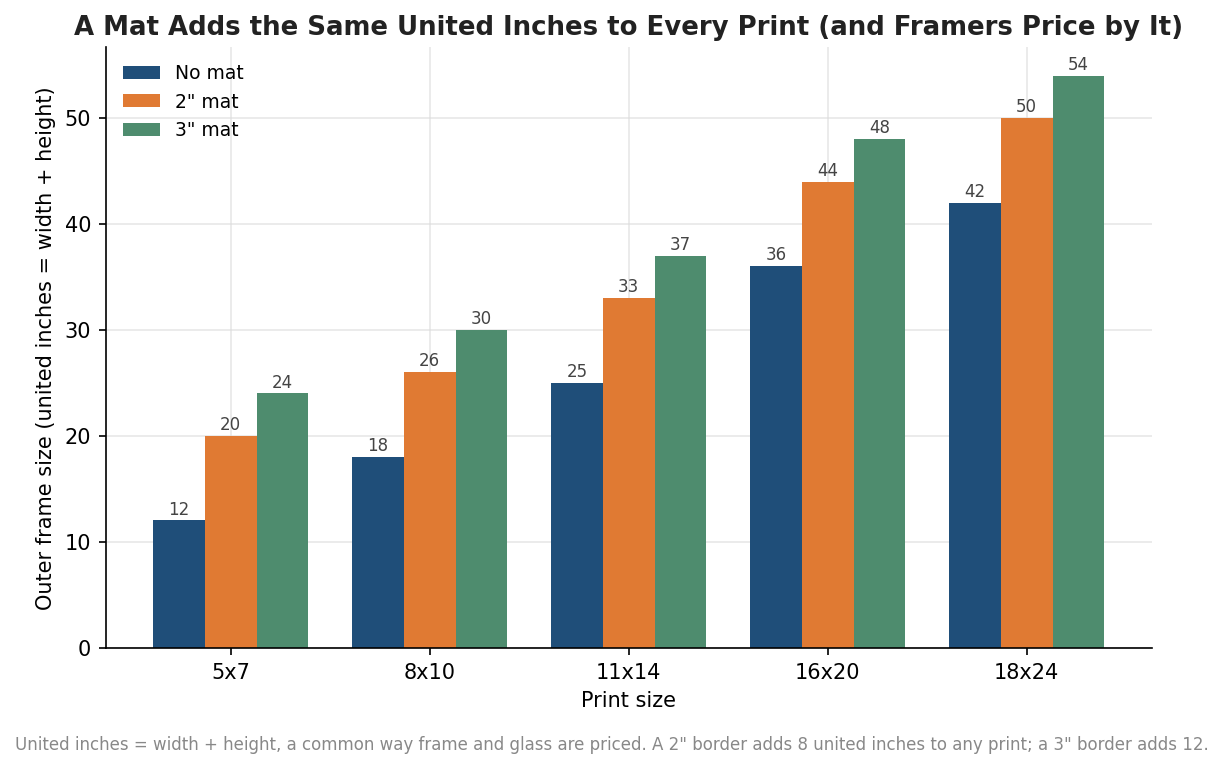
A mat is the single most common reason a bulk order comes back wrong, because the print size and the frame size are no longer the same number. Professional framers generally use a border of 2 to 4 inches, guided by the rule of thumb that the mat should read as clearly wider than the moulding so the frame does not overpower the image. The arithmetic is simple once you see it: a border adds twice its width to each dimension. An 8×10 print with a 2-inch mat needs a 12×14 frame; the same print with a 3-inch mat needs a 14×16. Because the border is added on all four sides, the increase is a constant, not a percentage. A 2-inch mat adds 8 united inches, meaning width plus height, to any print, and a 3-inch mat adds 12, whether the print is a 5×7 or an 18×24. The next chart makes that flat relationship visible.
Inside size, outside size, and the number that matters for glass
Three different measurements travel under the single word size, and mixing them up is what turns a clean spec into a reorder. Sight size is what you actually see through the opening, always a hair smaller than the art because the frame lip and any mat overlap the edge by roughly an eighth to a quarter inch. Inside or rabbet size is the opening the frame is built to hold, and most American frame makers label a frame by this number, so an 8×10 frame is built to hold an 8×10 assembly. Outside size is the moulding footprint on the wall, which grows with the width of the moulding face. For pricing and for glazing, the figure to track is united inches, the sum of width and height, because glass, acrylic and moulding are all quoted by length or area. That is also why glazing becomes a real decision as sizes grow: glass is rigid and scratch-resistant but heavy and breakable, while acrylic is roughly half the weight and far harder to shatter, at the cost of scratching more easily. Below poster sizes the choice is mostly preference; above them, weight and shipping risk tend to push large runs toward acrylic.
Speccing a bulk run without a reorder
A large order comes down to a few numbers locked before production. Decide the finished piece first, not the frame: know the print or art dimensions, whether there is a mat and how wide its border is, and only then back into the frame’s inside size. Standardize on as few distinct sizes as the project allows, because every size is a separate tooling, packing and inventory line, and consolidating a run onto three or four sizes usually lowers cost and error rate more than chasing a perfect fit for every image. Confirm whether your supplier labels frames by inside or outside dimension before you sign off, since that one ambiguity is responsible for a large share of mismatched orders. Ask about glazing and lead time in the same conversation, because acrylic, non-glare and UV-filtering options can move both the price and the schedule, and custom sizes typically add production time over stock sizes; treat any single lead-time figure as indicative and get your own quote in writing. Finally, have one sample built and approved against the actual print before the full run starts. A proof is far cheaper than a pallet of frames that miss by a quarter inch.