When you order custom picture frames in bulk, the glazing you put over the print quietly decides three things: how heavy each finished frame is to ship and hang, how well the art resists fading, and how much of the room you see reflected back instead of the image. The choice usually narrows to glass or acrylic, and then to which grade of each. Because the two materials behave differently on weight, safety, clarity and UV, the right answer depends on where the frames will hang and how they will travel to get there.
Weight is the difference you feel on every unit
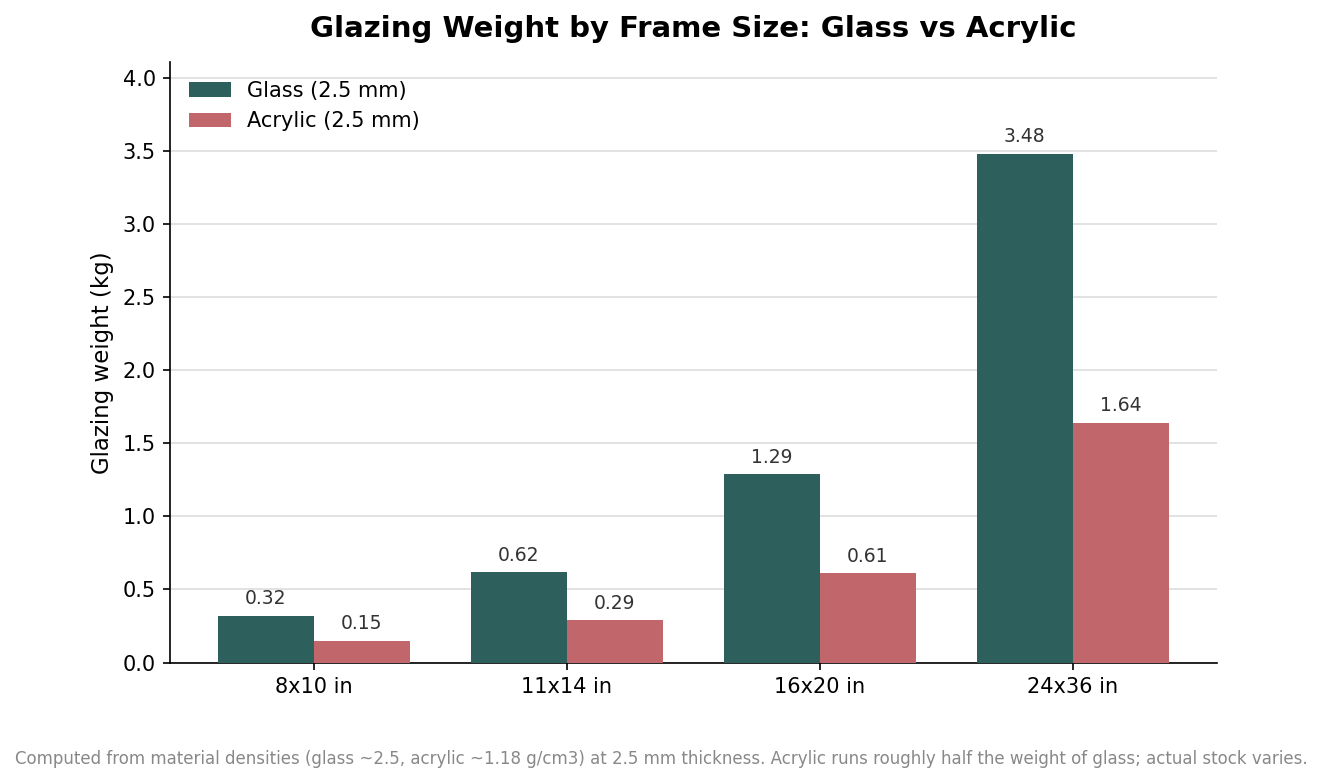
Acrylic runs roughly half the weight of glass at the same thickness, and that gap compounds across a bulk order. Glass has a density near 2.5 grams per cubic centimeter against about 1.18 for acrylic, so a sheet of each cut to the same size and 2.5 mm thickness lands acrylic at a little under half the mass. On a small 8×10 the difference is a few ounces and barely matters. On a 24×36 poster frame it is the difference between a glazing sheet near 3.5 kg in glass and closer to 1.6 kg in acrylic, and that flows straight into shipping weight, the load on a wall anchor, and how safe the piece is over a desk or a child’s bed.
For large formats, high quantities, or anything shipping by parcel carrier, the weight case for acrylic is strong enough that it often decides the order on its own. For small tabletop frames, weight is close to a non-issue and other factors take over.
Safety and durability pull in opposite directions
Acrylic wins on breakage; glass wins on scratches. Acrylic is shatter resistant, so it survives a drop, a bump on a loading dock or a bounce in transit that would crack glass, which is why it is the default for shipping, high-traffic hallways, schools and anywhere at reach of hands. The trade-off is surface hardness: acrylic scratches easily and needs a soft cloth and a gentle cleaner, while glass is hard enough to wipe down without much thought and keeps a pristine face for years. Acrylic also carries a mild static charge, so it is a poor choice directly against loose media like charcoal or pastel, which it can lift off the surface.
Translate that into venues. Frames headed to a busy office, a gym, a daycare or a trade-show booth favor acrylic for the safety margin. Frames that will sit undisturbed on a wall in a gallery, a home or a boardroom can take glass and reward it with a harder, more scratch-proof surface.
UV protection is a grade choice, not a material choice
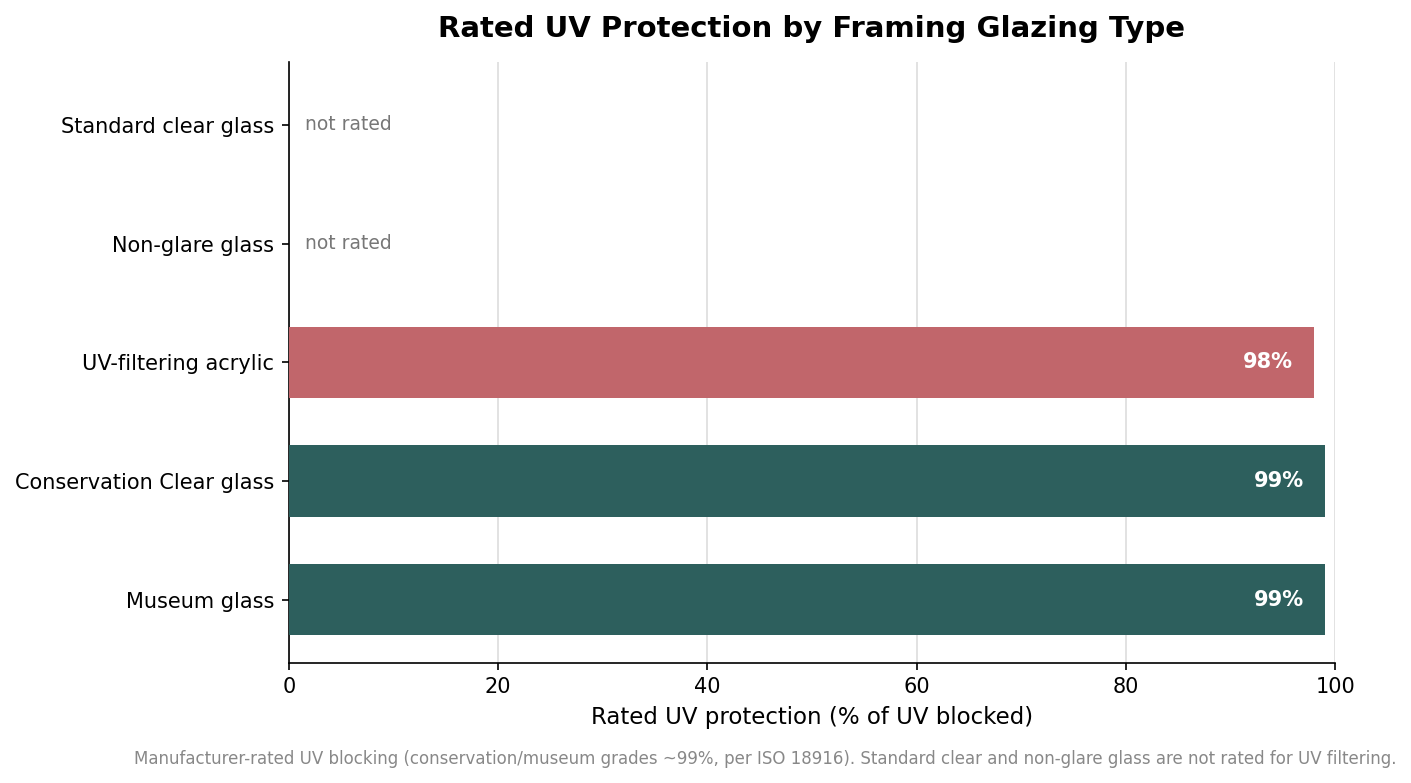
Standard clear glass is not rated to filter UV, and neither is basic non-glare glass; both protect against dust and handling but let the light through that fades a print over months and years. Meaningful UV protection is a specific grade. Conservation-grade glass blocks up to about 99 percent of UV and is built to meet framing preservation standards such as ISO 18916, and museum glass adds an anti-reflective coating on top of the same UV performance. On the acrylic side, UV-filtering grades block on the order of 98 percent, so you can get conservation-level protection in the lighter, shatter-resistant material if you specify it.
The practical point is that “glass” alone tells you nothing about fade protection. If the art is valuable, sentimental, or hung anywhere near a window or bright store lighting, the line item you care about is the UV grade, and it exists in both glass and acrylic.
Clarity, reflection and the cost that follows
Optically, plain acrylic is actually a touch clearer than plain glass, because standard glass carries a faint green tint from its iron content that slightly dims and colors what sits behind it. Where glass pulls ahead is at the premium end: reflection. Museum and other anti-reflective glasses cut mirror-like glare by more than 85 percent while still transmitting over 97 percent of light, giving that near-invisible look that is hard to match. Non-glare glass is the budget way to kill reflections, but it does so with a frosted surface that softens the image, so it suits multi-mat pieces more than sharp photographs.
On price, the base materials invert the premium ones. Plain glass is usually the cheapest glazing, with standard acrylic a step up; but once you move to UV-filtering acrylic or anti-reflective museum glass, cost climbs and the ranking can flip. For a bulk program, the honest way to decide is to fix the venue and the protection you actually need first, then price the specific grade in each material rather than assuming one is always cheaper. Where a figure here is indicative rather than a published spec, treat it as a starting point and confirm the exact grade with your supplier before you commit a large run.
How to write the glazing line on a bulk order
Decide the venue before the material, because location settles most of the trade-offs at once. A high-traffic, ships-a-lot, hands-can-reach-it setting points to acrylic for weight and safety, and you then pick standard or UV-filtering depending on whether fading is a concern. A stable, undisturbed wall for valuable art points to glass, and you choose between conservation grade for protection alone or museum grade when glare control also matters. Only after those two calls does the exact grade, and its price, come into focus.
A complete glazing spec names four things: the material, the grade, the thickness, and the finish. That reads as something like “2.5 mm UV-filtering acrylic, standard finish” for a shipped office program, or “2.5 mm museum glass, anti-reflective” for a gallery reorder. Pin those down and the quote you get back is comparable across suppliers, the reorder matches the first run, and you avoid the common bulk mistake of ordering “glass” and discovering later that it never protected the print at all. If any single frame will be oversized, revisit the weight question one more time, since that is where acrylic most often pays for itself.