Most framing guides start with the glass and the mat, but the moulding, the profile that forms the frame itself, is the decision that quietly sets everything else: what the order costs, how heavy the finished piece is, how big you can safely go, and whether it survives a humid stockroom. The four materials that dominate custom framing, polystyrene, engineered wood, solid wood, and aluminum, are not interchangeable, and choosing by looks alone is how a bulk order comes back too heavy for the wall or too fragile for the size. This is a working comparison of what each material is good at and where it stops making sense.
Why the moulding material is the first decision
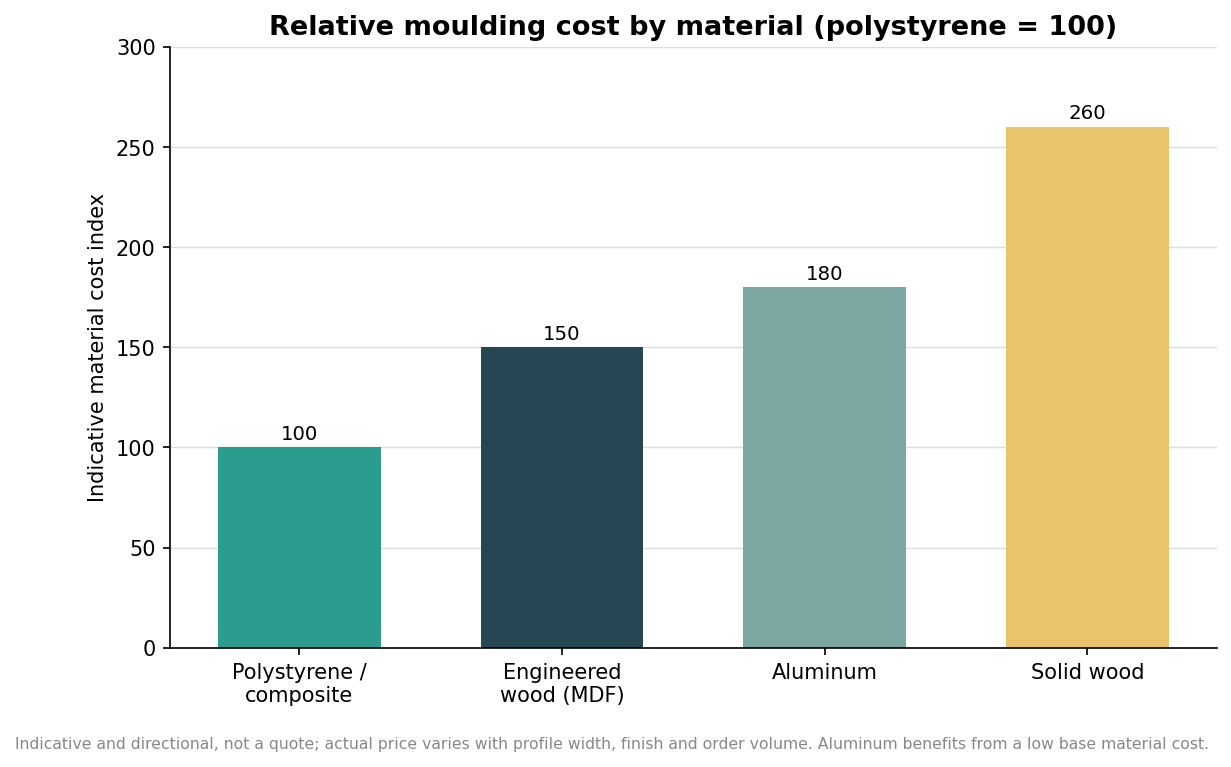
Before finish or color, the material governs three things that are hard to change later. It sets cost, since the raw stock ranges from inexpensive molded plastic to premium hardwood. It sets weight, which determines how the frame hangs and how far a wall fixing has to be rated. And it sets the practical size ceiling, because a profile that stays straight at eleven by fourteen inches can bow or rack at thirty by forty. A useful way to think about a frame order is to fix the largest size and the environment first, let those narrow the material, and only then choose the finish, rather than falling for a finish and discovering it does not come in a moulding that can carry your print.
Polystyrene and composite: light, affordable, moisture-proof
Polystyrene moulding, often sold as composite or simply plastic, is the value workhorse of custom framing. It is extruded from a molded profile, which makes it inexpensive at volume and lets it reproduce ornate, detailed patterns that would be costly to carve in wood. It is lightweight, which simplifies shipping and hanging, and it is genuinely resistant to moisture and warping, so it holds up in bathrooms, kitchens, and humid storage where real wood struggles. The trade-off is structural: a plastic profile is less rigid than wood or metal, so it is happiest on small and medium pieces rather than oversized art, and very cheap versions can look flat under close inspection. For high-volume decor, promotional framing, and anywhere the piece is small to mid-sized, polystyrene usually wins on cost per unit without a real quality penalty.
Solid and engineered wood: finish range at a weight and moisture cost
Wood is the material people picture when they think of a quality frame, and it earns that reputation on finish versatility. It can be milled to almost any profile width and treated with an essentially unlimited range of stains, paints, and natural finishes, and different species carry different grain and warmth. The distinction worth understanding is between solid wood, which is usually the most expensive option and the heaviest, and engineered wood such as MDF or finger-jointed poplar, which sits in the middle on price and holds a painted or veneered finish very consistently. The shared weakness is the environment: wood is vulnerable to humidity and temperature swings, and a joined wooden frame can twist or open at the corners if it is stored or hung somewhere damp. Wood is the right call when the finish and feel matter and the conditions are stable, and engineered wood is often the smarter buy when you want the look of a painted wood profile at a controlled cost.
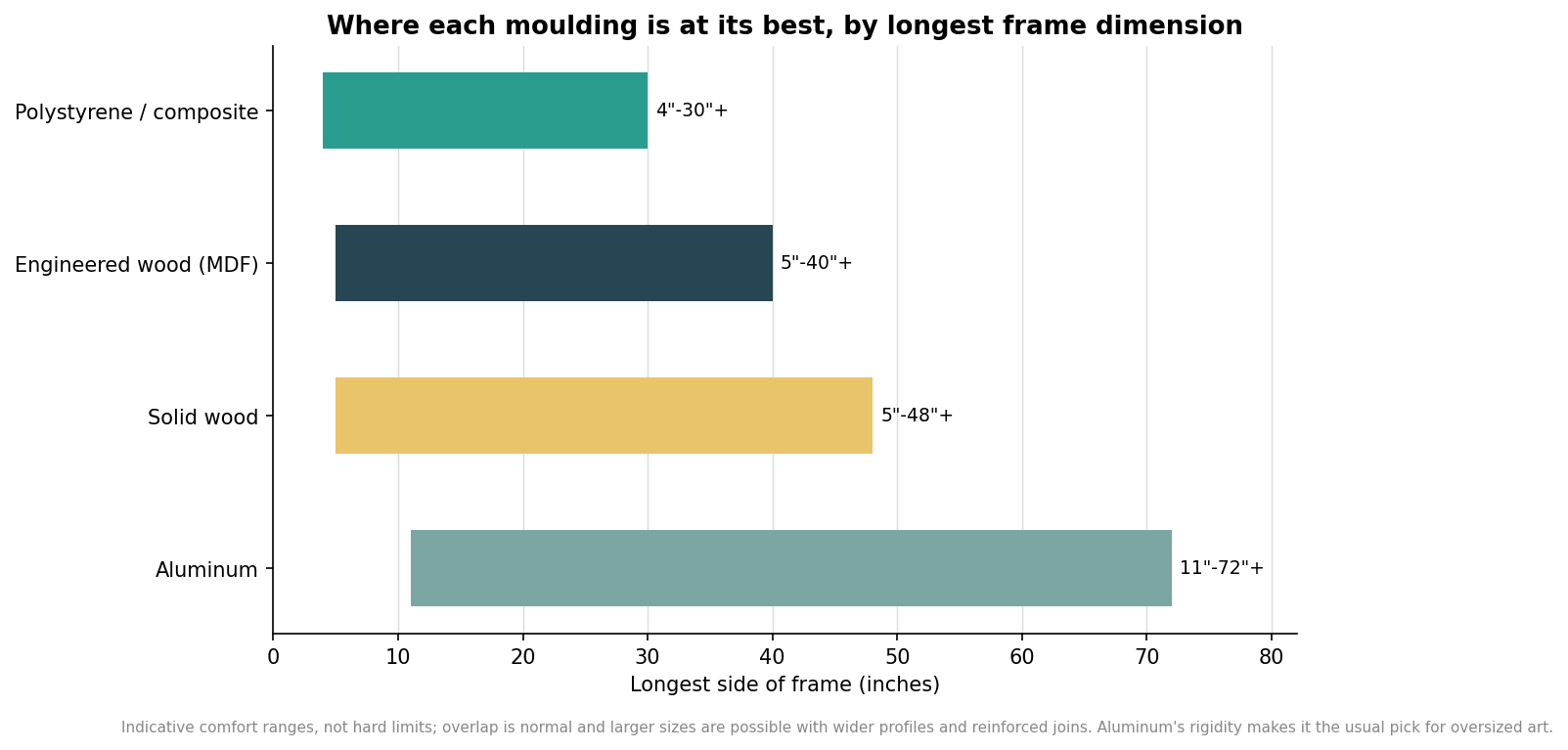
The size ranges above are comfort zones rather than hard limits, and they overlap on purpose. Wider profiles and reinforced corner joins push any material larger than shown; the chart marks where each moulding is doing its easy work versus where you are asking a lot of it.
Aluminum: the material that scales to oversized
Metal moulding, almost always aluminum, is the specialist for large and demanding pieces. Aluminum is extruded under enormous pressure into a rigid profile that does not warp, twist, or chip easily, and it is remarkably light for its strength: a large aluminum frame in the range of forty by sixty inches can weigh only a couple of pounds, which is why oversized posters and gallery pieces so often use it. Because aluminum is one of the most abundant materials there is, the base stock is affordable, though finishing and hardware add to the delivered price. The limitation is aesthetic rather than structural: extrusion and anodizing or powder coating cannot reproduce the deep embossed detail of a molded or carved profile, so the look tends toward clean and contemporary. When the art is big, the wall time is long, or the environment is tough, aluminum’s rigidity and light weight are hard to argue with.
Choosing by size, environment, and finish
The decision usually resolves cleanly once you stack the three constraints. If the piece is small to medium and cost-sensitive, polystyrene delivers the widest range of detailed looks for the lowest unit cost. If finish and material feel carry the piece and the setting is climate-stable, wood is worth its premium, with engineered wood as the value path to a painted look. If the art is large, or the environment is humid or high-traffic, aluminum’s rigidity and low weight make it the safe structural choice. Two habits keep a bulk order from going wrong regardless of material: order a single sample corner in the exact profile and finish before committing the run, and confirm the moulding’s rebate depth accommodates your glazing, mat, and backing stack so the frame closes properly. Get the material right first and the rest of the frame spec falls into place around it.